- Estate documents not aligned with assets
- Retirement accounts not coordinated with legacy planning
- Income strategies not protected against long-term risks
- Life insurance not integrated into the overall plan
- No defined asset transfer strategy
- Business or real estate not structured for transition
Who We Are
Estate planning is often handled separately from retirement planning and financial decisions are made without full coordination across both.
Led by Certified Estate Planner Jennifer B. Barthol, the firm brings together estate planning structure, retirement strategy and financial coordination into a unified planning approach.
This is not a product-driven model.
It is a planning-first, coordination-based structure built to help individuals and families make informed decisions across multiple areas of their financial lives.
New York Foundation
Jennifer began her career in New York City as a Registered Representative & Annuity Correspondent, gaining early exposure to retirement income planning, suitability standards and long-term financial strategy.
Estate Planning Integration
Her transition into estate planning as a paralegal provided direct insight into trust structures, wills and the legal framework behind wealth transfer.
Bridging Two Worlds
Recognizing that estate and financial planning were often handled separately, she developed a coordinated approach that aligns both disciplines.
ERFPE Formation
ERFPE was created to provide a structured planning model — one that connects estate planning decisions with retirement and financial strategies.
Multi-State Planning Experience
Today, ERFPE supports individuals and families across multiple states through an attorney-connected and coordination-based process.
Bridging Two Worlds
Recognizing that estate and financial planning were often handled separately, she developed a coordinated approach that aligns both disciplines.
Planning Philosophy
Having documents alone does not complete a plan. Having investments alone does not complete a plan.Alignment between them is where planning becomes effective.
- How assets are titled and transferred
- How income is sustained throughout retirement
- How beneficiaries receive what is intended
- How decisions made today impact long-term outcomes
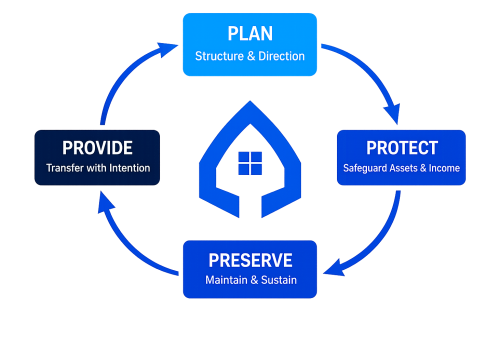
ERFPE INTEGRATION FRAMEWORK
The 4 Pillars of Coordinated Planning
PLAN
Structuring decisions with clarity and intent
PROTECT
Addressing risks that may impact assets and income
PRESERVE
Maintaining efficiency across taxes, transfers and timing
PROVIDE
Ensuring outcomes align with long-term goals and legacy intentions
This framework serves as a reference point for how planning decisions are evaluated and coordinated.
What Happens Without Coordination
Most individuals we work with already take meaningful steps toward planning.
The challenge is not starting — it is ensuring everything works together.
WHO WE SERVE & THE PATHS TO COORDINATED PLANNING
Path 1: Individuals & Families
Those seeking clarity around estate planning, retirement income and how their financial decisions align.
Common considerations include:
- Establishing or updating trusts and estate structures
- Coordinating retirement accounts and beneficiary designations
- Planning for income stability and long-term distribution
- Ensuring assets transfer efficiently to intended beneficiaries
Professionals, Business Owners & High-Net-Worth Households
Business owners, professionals and higher-net-worth individuals requiring more structured coordination.:
Common considerations include:
- Business succession and exit strategy alignment
- Multi-state estate planning coordination
- Advanced trust structures and asset protection strategies
- Integration of retirement income with estate planning objectives
- Coordination between legal, financial and tax professionals
ERFPE operates through a coordinated, attorney-connected planning process.
- Estate planning documents are prepared by licensed attorneys in accordance with state law
- Planning is approached through education, structure and coordination
- Recommendations are made based on suitability and alignment with stated objectives
- Multi-disciplinary collaboration is used when appropriate
ERFPE does not provide legal or tax advice but t provides coordination, structure and planning guidance.
WHY INTEGRATION MATTERS
Without coordination
- Estate documents may not align with asset ownership
- Beneficiary designations may override intended outcomes
- Retirement income strategies may not reflect estate objectives
With coordination
- Planning decisions work together
- Strategies are aligned across disciplines
- Outcomes are more predictable and intentional
Is ERFPE Right For You?
A structured assessment is available to help determine whether a coordinated planning approach aligns with your current situation.
(Results are reviewed and delivered within 24–48 hours.)
Planning is not simply about what you have. It is about how everything works together.
Legal documents are prepared by licensed attorneys. ERFPE does not provide legal or tax advice.
What Happens Without Coordination
Most individuals we work with already take meaningful steps toward planning.
The challenge is not starting — it is ensuring everything works together.
Where Plans Often Break Down
- Estate documents not aligned with assets
- Retirement accounts not coordinated with legacy planning
- Income strategies not protected against long-term risks
- Life insurance not integrated into the overall plan
- No defined asset transfer strategy
- Business or real estate not structured for transition
THE ERFPE PLANNING FRAMEWORK (4 PILLARS)
This is not fragmented planning. It is a coordinated framework designed for families, professionals, business owners and high-net-worth individuals
who want more than documents — they want structure. The four elements within the ERFPE logo reflect the firm’s planning philosophy,
Plan. Protect. Preserve. Provide.
THE ERFPE DIFFERENCE - A New York Foundation Advisory Model
Each area of planning has its place and important on its own but integration gives it purpose. Through education, coordination and alignment, every component is positioned to function as part of a unified framework, alongside your legal and financial professionals where appropriate.
TRADITIONAL APPROACH*
Focus begins with documents
Estate planning is frequently executed independently, especially when using DIY or generic online form; may not fully align with financial strategy,
Beneficiary designations may be uncoordinated
Limited review of retirement assets may unintentionally supersede trust direction
Clients leave with completed legal documents- good decision on its own
Estate planning and retirement planning are often handled independently – at different times and with different professionals
Funding a trust and asset alignment are often addressed separately
Multiple advisors may operate independently within their respective areas, insurance agents, wealth managers, estate planners etc
ERFPE COORDINATED MODEL
Strategy begins before documents
Estate, retirement and financial planning are aligned to operate seamlessly as part of a cohesive, integrated strategy.
Coordinated review of income, assets and estate structure
Beneficiary alignment integrated into planning
Clients leave with an integrated strategy and clarity where each component is aligned through integration.
Estate distribution and retirement income strategies are aligned within a unified framework to ensure efficient outcomes
Guided trust funding and asset alignment process
Coordination across legal, financial and advisory roles is emphasized to align all moving parts into a cohesive, wellstructured planning framework
*We do not replace attorneys; we prepare you for them.
Having documents is one step. Ensuring those documents function properly within your financial life is another.
Without coordination, even well-prepared plans can lead to delays, inefficiencies, or unintended outcomes.
Estate planning without retirement strategy is incomplete. Retirement planning without estate coordination is equally incomplete. When these areas are addressed separately, gaps are created. Those gaps often appear later — during incapacity, transition, or loss.
ERFPE was built to close that gap.
BEFORE YOU DECIDE
Consider: A Brief Pre-Call Fit Check Before Booking
Your answers below will help you determine the most appropriate starting point and help you select the right session if you choose to move forward.
WHAT YOU SHOULD KNOW BEFORE BOOKING.
While many conversations are offered at no cost, this fee supports a structured, education-first approach focused on coordination, clarity and your overall planning strategy. Most “free” conversations are product-driven. This process is designed to provide clear direction before any decisions are made
Each session is focused on understanding your current structure, identifying potential gaps and determining how your estate, retirement and financial components align.
The goal is to provide clarity and direction—not to sell a product.
That’s completely normal. Most individuals find that one of the three options is appropriate for their situation—even if they’re not yet sure where to start. If additional time or discussion is needed beyond your scheduled session, a follow-up consultation can be arranged